WISP
An AI host with presence and no face, built to feel like something is there without pretending to be someone.
Self-initiated concept. Its own brand. A scripted demonstration, not a live AI model.
Problem
AI interfaces either hide in a chat box or fake a face. WISP takes a third path: a faceless presence made of light you can feel in the room without it pretending to be a person.
The question is what an AI host looks like for live formats when honesty is the constraint, present and responsive, never cosplaying as human.
System
One mechanic: feeling without a face. A faceless form of light reacts through seven states, idle, listening, thinking, speaking, delight, hesitation, and quiet care, each with its own motion and intensity. A breath baseline keeps it alive between moments.
The brand is warm, not cold-tech, and the whole thing is voice-first. The honesty is explicit: not a person, not pretending.
Presence system
Seven states carry emotion.
→Breath baseline
Alive between moments.
→Voice-first interaction
Built to be spoken to.
→Warm brand system
Inviting, not clinical.
Decisions
A few choices keep it honest and present. Presence usually gets built out of likeness, a face, a name, a voice; here it is built out of light, motion, warmth, and a deliberately small vocabulary of states. Each of those reads faster at a glance than a face would, and none of them ask the viewer to believe it is a person.
Feeling without a face
Presence from light and motion, not an avatar, so the system never depends on human likeness and sidesteps the uncanny-valley risk entirely.
Honesty is the design
It states what it is. Admitting it makes it more trustworthy, not less.
Seven states, one mechanic
A small, legible emotional vocabulary reads instantly.
Warm, not cold-tech
A live host has to feel inviting to sit with.
Output
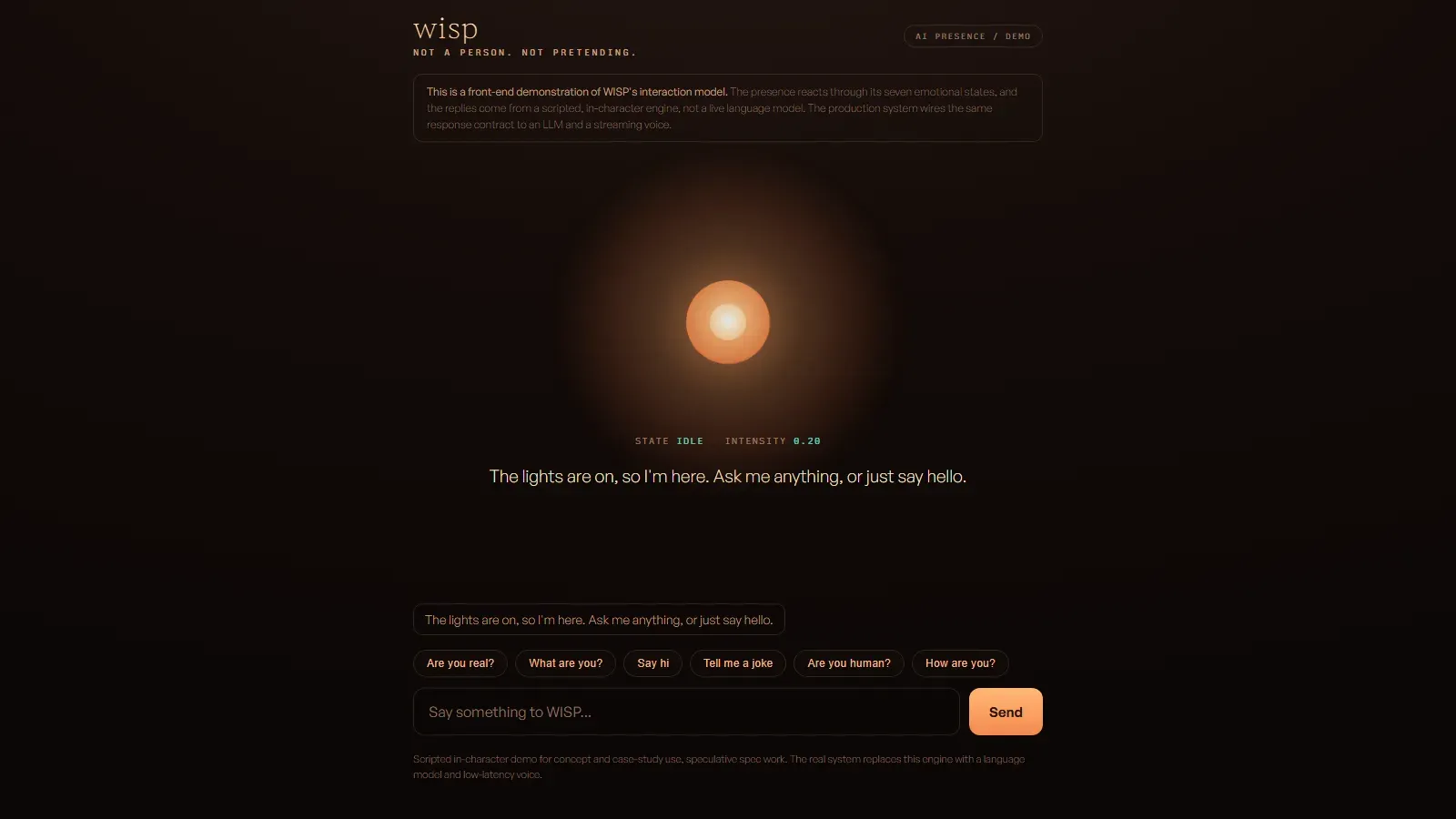 Open ↗
Proof
WISP is self-initiated and its own invented brand. The figures are scope, not outcomes. The demo is a scripted presentation of an interaction model, not a live AI product.
Reflection
WISP is about interaction design for AI presence, the part most AI products skip. It shows how presence, motion, and honesty combine into a live-feeling interaction model on screen, without faking a human to get there.