Level
A prediction-market app built around restraint, where understanding the bet is the product, not the thrill of it.
Self-initiated concept. Its own invented brand, not a real product.
Problem
Most prediction markets borrow their mechanics from casinos. Celebrate the win, hide the risk, push the next bet. Level starts from the opposite stance: make the odds legible, slow the user at the right moments, and treat a win and a loss as the same event.
The concept is an argument that you can design this category for trust instead of compulsion.
System
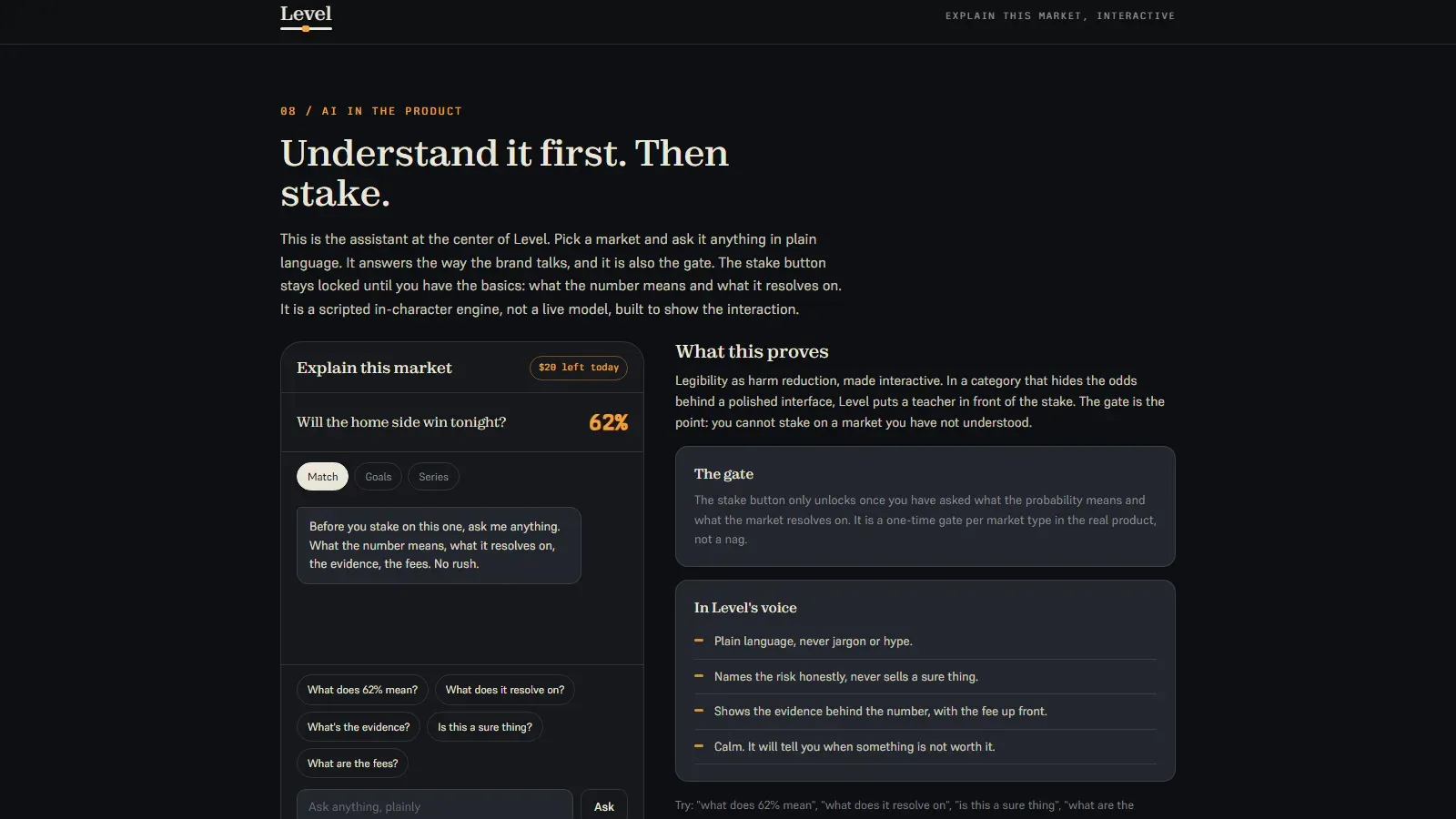
Guardrails, not engagement bait. Limits are on by default from onboarding. A scripted market-explainer gates every market: you can't stake until it makes sense to you, asked in plain language. Probability and risk get their own visual language.
And the motion system refuses to celebrate. A win resolves the same way a loss does.
Brand + trust system
One language for a careful product.
→App, limits on by default
Responsible use is the default.
→Explain-this-market gate
Understanding before staking.
→Risk + probability visuals
Make the odds felt, not buried.
Decisions
Four choices kept it honest. Each one removes a lever this category normally pulls, and each one costs something: a limit that ships on is friction, a gate before staking is a slower funnel, a resolution without celebration is a weaker hook. Level takes all four trades on purpose.
Limits on by default
Responsible use is the default state, not a setting a careful user has to find.
Understanding as a gate
You can't stake on a market until you've engaged with what it actually means.
No celebration
Winning and losing resolve with the same visual weight, so the interface never rewards one outcome over the other.
Make probability legible
Risk and odds get real visual treatment instead of fine print.
Output
Proof
Level is self-initiated and its own invented brand. The figures are scope, not outcomes. No users, engagement, or revenue is claimed, and it is not a real financial product.
Reflection
Level is the counter-argument to how this category usually gets designed. It shows product thinking under an ethical constraint: clarity, restraint, and trust as design problems, not compliance bolted on at the end.